
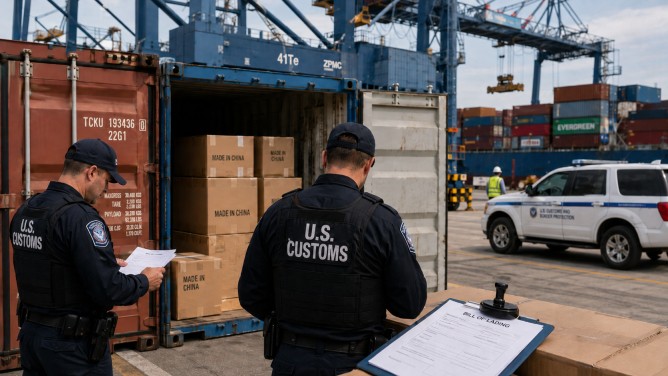
The United States has implicated 38 countries and the European Union in what it describes as a “shadow transshipment network,” which allegedly facilitates the entry of Chinese products, subject to hefty U.S. tariffs, into the American market via intermediary countries. This accusation stems from a report titled “The Great Transshipment Scam,” which estimates that these potentially illicit activities might account for approximately $60 billion in trade. The report claims that this practice has led to substantial losses in U.S. tariff revenue.
The document identifies a wide array of countries and territories involved in this network, including major players like India, Canada, the European Union, Israel, and Japan, as well as others such as Mexico, South Korea, Taiwan, Brazil, Indonesia, Malaysia, Thailand, and Turkey. Additionally, it lists Vietnam, Argentina, Azerbaijan, Bangladesh, Cambodia, Chile, Colombia, Costa Rica, the Dominican Republic, Georgia, Jordan, Kazakhstan, Kenya, Laos, Morocco, Myanmar, Oman, Panama, Peru, the Philippines, Singapore, Sri Lanka, Switzerland, the UAE, and Uzbekistan.
According to the report, in 2025, approximately $67 billion worth of goods destined for the U.S. were allegedly rerouted from China through major transshipment hubs, notably Mexico, India, and Vietnam. This redirection is estimated to have resulted in about $28 billion in lost tariff revenue for the United States. The report further scrutinizes the Pune-Gujarat-Chennai corridor in India, suggesting that Chinese shipments of items like electric pumps and compressors have benefited local businesses while posing increased competition for U.S. manufacturers.
In response to these allegations, the report outlines a series of potential measures the U.S. might adopt. These include the implementation of more rigorous inspections and interdiction processes, the imposition of additional tariffs, the enactment of sanctions, and possibly restricting market access to countries that are found to facilitate tariff evasion.