
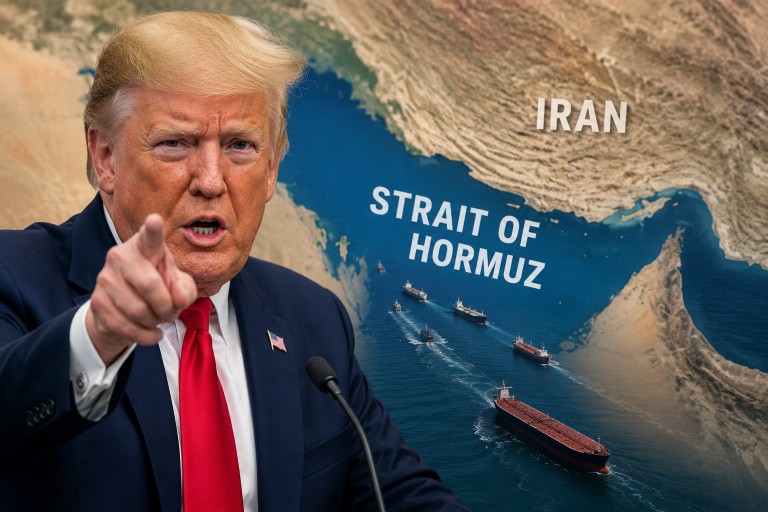
Tensions between the United States and Iran escalated as President Donald Trump suggested the possibility of declaring the Strait of Hormuz a U.S. territory amid ongoing conflicts. Speaking in New York, Trump hinted that such a declaration could be made “pretty soon” following a U.S. victory over Iran, asserting that the U.S. already effectively controls the vital maritime passage through a blockade. The Strait of Hormuz is a critical shipping lane for global oil, with around 20% of the world’s seaborne oil passing through it. The strait, located between Iran and Oman, has largely been closed off since the U.S. and Israel initiated military actions against Iran.
The uncertainty surrounding Trump’s statement raises questions about whether it indicates an official shift in U.S. policy or simply serves as a political maneuver. Iran swiftly dismissed the threat, with Deputy Foreign Minister Kazem Gharibabadi stating that Tehran would not succumb to U.S. pressure and emphasized Iran’s authority over decisions regarding the strait’s operations. Meanwhile, Iranian Foreign Minister Abbas Araqchi clarified that Tehran has not agreed to resume negotiations with Washington, noting that current communications via Qatar and Pakistan do not amount to formal discussions.
Iran has set forth several preconditions for reopening the strait to shipping, which include compensation for war-related damages, the lifting of sanctions, and the release of frozen Iranian assets. The conflict and the resulting disruption to shipping have led to an increase in fuel prices, placing additional financial burdens on consumers. Trump defended the higher prices, arguing that the additional cost is a necessary measure to prevent Iran from developing nuclear weapons.
The impasse over the Strait of Hormuz has intensified worries about the stability of global energy supplies and the broader economic repercussions of the ongoing conflict. As the situation remains unresolved, the international community watches closely, considering the significant implications for energy markets and geopolitical stability.