
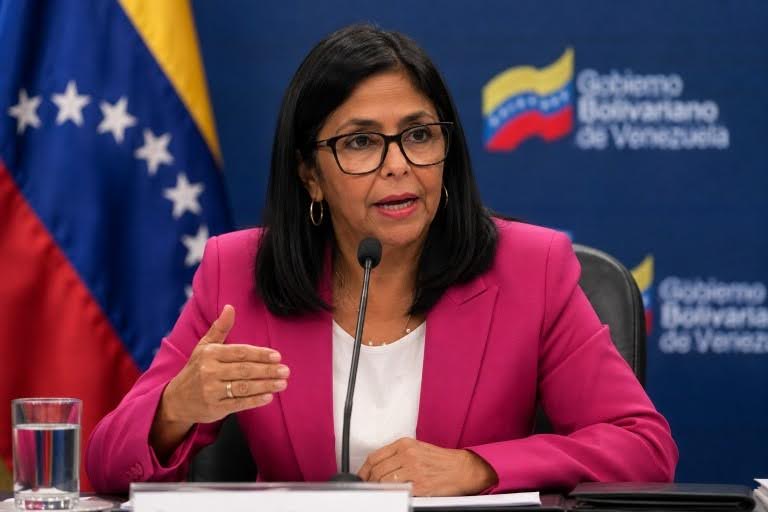
Venezuela’s interim president, Delcy Rodríguez, has come forward to defend a contentious energy agreement with the United States amid significant domestic criticism. Addressing the nation, Rodríguez emphasized that Venezuela would retain ownership and sovereignty over its oil reserves, countering accusations that the deal represents a concession of national resources to Washington. Although the agreement has sparked controversy, Rodríguez highlighted its potential to generate over $209 billion in revenue, positioning Venezuela as a key player in the global energy market. She stressed that without the necessary investment, technology, and infrastructure, the country’s vast oil reserves could not translate into tangible economic benefits for its citizens.
The agreement, which was reportedly negotiated in secret over several months, grants the United States control over a significant portion of Venezuela’s crude reserves. These reserves are the largest in the world, surpassing those of Saudi Arabia and Iran. Rodríguez revealed that the deal encompasses 17 crucial oilfields with a production target exceeding 1.5 million barrels per day. This development has drawn sharp criticism from both opposition leaders and members of Rodríguez’s own political faction, who view it as a resource grab. A former state oil executive labeled the arrangement a betrayal of national sovereignty, noting that such a transfer of reserves is unprecedented in Venezuela’s history.
Protests have erupted in Caracas, with demonstrators decrying what they perceive as foreign encroachment on the nation’s resources. On social media, users have mocked the agreement, suggesting the state oil company undergo a rebranding. This move marks a significant reversal for Rodríguez and her political allies, who have traditionally opposed foreign control over Venezuela’s natural resources. Rodríguez’s past public statements have warned against similar arrangements, making the current deal a striking departure from previous stances.
Opposition figures have expressed concerns that the agreement might undermine efforts to restore democratic elections in Venezuela. They argue that the country’s economic prosperity hinges on transparent governance and free elections, without which the deal might rest on an unstable foundation. While the exact timing for future elections remains uncertain, critics maintain that lasting economic benefits are contingent upon establishing a democratic and transparent political environment.