
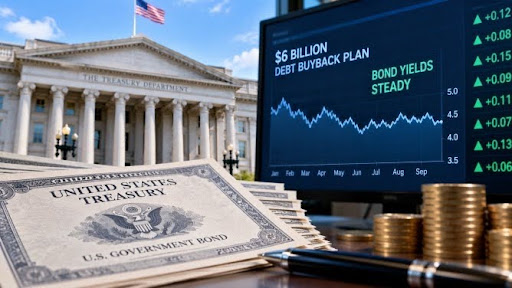
The US Treasury’s efforts to curb rising borrowing costs hit a stumbling block as government bond yields continued to climb, despite plans to repurchase $6 billion in Treasury securities. Announced by Treasury Secretary Scott Bessent on Wednesday, the buyback aims to mitigate a selloff that has been exerting upward pressure on interest rates. However, this move has not succeeded in calming investors, with the yield on 10-year Treasury bonds reaching its highest point in three years.
The 30-year Treasury yield has surged to approximately 5.2%, marking its highest level since the 2008 financial crisis. This uptick is driven by persistent inflation and geopolitical uncertainty, particularly the ongoing conflict in Iran, which have shaken the confidence in US government debt, typically considered a safe investment. In August, Bessent indicated that the Treasury would at least double its typical debt buyback operations to stabilize the market by reducing the bond supply, a strategy expected to lower yields. Despite these efforts, yields have continued to rise since the announcement.
The US government debt soared past $40 trillion in August, doubling over the past decade, and the increasing Treasury yields could lead to higher borrowing costs for consumers, affecting mortgage, student loan, and auto financing rates. This situation complicates matters for the US Federal Reserve, already grappling with sustained high inflation. Annual inflation peaked at a three-year high in May before declining to 3.4% in July, which remains 0.7 percentage points higher than the same time last year, fueled partly by rising energy costs.
Escalating oil prices have further compounded these concerns, with Brent crude surpassing $100 a barrel on Wednesday, driven by intensifying conflict in the Middle East. These developments present the Federal Reserve with a challenging task of balancing inflation control through interest rate adjustments with political pressure from President Donald Trump, who has consistently advocated for lower rates.