
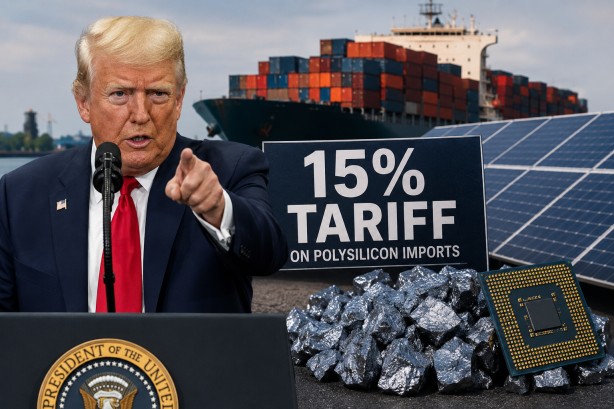
In a move aimed at bolstering domestic production and reducing dependency on Chinese imports, US President Donald Trump has introduced a 15% tariff on imported goods made with polysilicon. This tariff, scheduled to take effect on December 4, targets a critical material used in the production of semiconductors and solar panels. Polysilicon is an ultra-pure form of silicon essential for manufacturing semiconductors that drive artificial intelligence systems and data centers, as well as solar cells and panels. Currently, China dominates the global production of this material.
The new tariff measures include setting minimum import prices for various polysilicon products: $21 per kilogram for raw polysilicon, $100 per kilogram for polysilicon ingots and wafers, $0.22 per watt for solar cells, and $0.38 per watt for solar modules and panels. The US administration states that these steps are designed to enhance the viability of domestic polysilicon manufacturing and to secure critical supply chains that are vital for economic and national security.
Reacting to the announcement, China has criticized the US decision, arguing that it unjustly uses national security as a pretext to limit Chinese business activities. The Chinese government warns that such protectionist measures could disrupt trade relations between the two countries, which might have broader economic implications.
Currently, the US is home to two major polysilicon production facilities, operated by Hemlock Semiconductor in Michigan and Wacker Chemie in Tennessee. The new policy also opens the door for the US government to offer incentives to companies that invest in domestic polysilicon production and related manufacturing facilities, potentially leading to increased domestic output in this critical sector.
This tariff measure comes amid a backdrop of robust growth in China’s export sector, especially in electronics, artificial intelligence-related products, and other high-value manufacturing industries. The US decision reflects ongoing efforts to recalibrate trade policies and supply chains in response to global economic shifts and geopolitical challenges.