
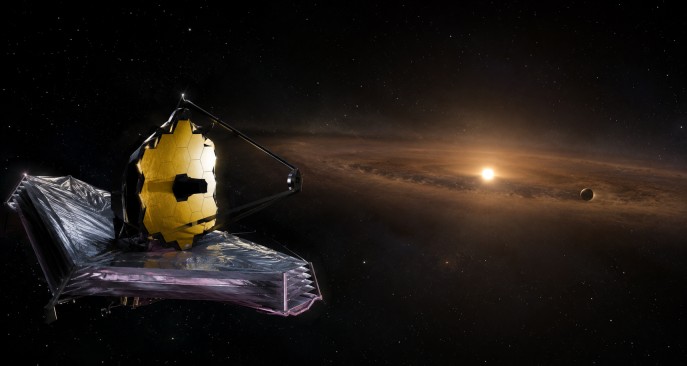
Astronomers have made a groundbreaking discovery using NASA’s James Webb Space Telescope: a new exoplanet named Beta Pictoris d has been found orbiting the star Beta Pictoris. This addition brings the count of known giant planets in this closely studied system to three. Unlike the other two planets, Beta Pictoris d was detected not through direct imaging but by identifying the distinct chemical signature of its atmosphere, offering a fresh perspective on planet detection.
The discovery came as a surprise to researchers who were initially using the telescope’s Near-Infrared Spectrograph (NIRSpec) to focus on another planet within the same system. By analyzing the atmospheric composition and movement of Beta Pictoris d, scientists were able to confirm its presence. The planet’s atmosphere revealed traces of carbon monoxide, water vapor, and methane, indicating its classification as a giant planet. It resides within the system’s luminous debris disk, which had previously obscured it from traditional imaging methods.
Situated about 63 light-years away from Earth, the Beta Pictoris system is approximately 23 million years old. It provides an invaluable opportunity for scientists to study the formation and development of planetary systems. Beta Pictoris d is estimated to have a mass at least twice that of Jupiter and maintains an orbit around its star that is similar in distance to Neptune’s orbit in our solar system.
This discovery marks a significant milestone as it is the first time an exoplanet has been identified primarily through moderate-resolution spectroscopy. This innovative method could potentially revolutionize the search for planets, particularly those hidden within dusty environments like the Beta Pictoris system. Researchers are hopeful that this technique will enhance the ability to identify more exoplanets throughout the Milky Way, providing new insights into the universe beyond our solar system.